Inside AI agents and tool use, the complete guide for operators
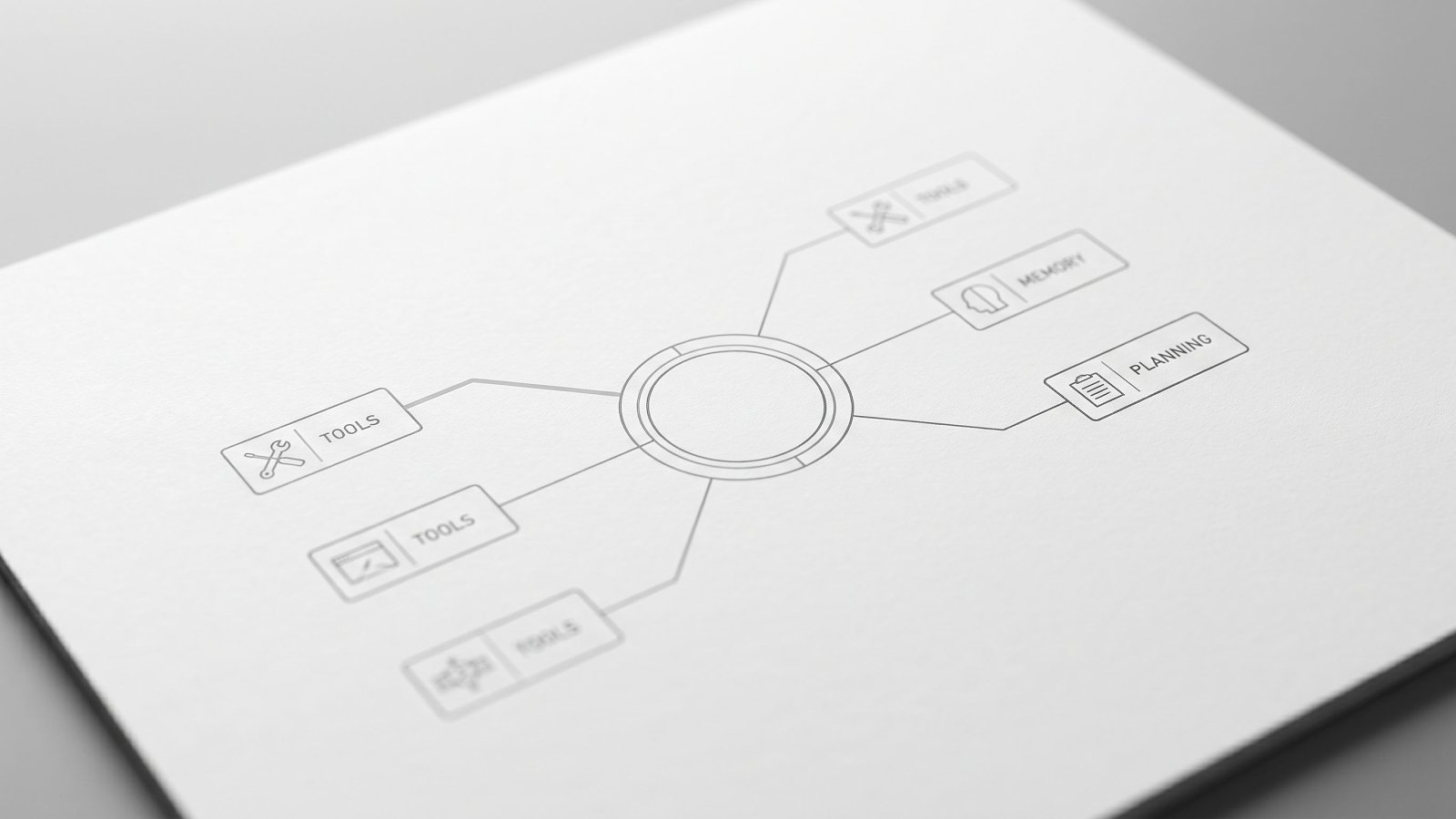
AI agent tool use architecture is the set of design decisions that lets a language model plan a task, call external tools, read the results, and decide its next move without a human approving every step. For a product lead owning next year's AI roadmap, that definition is the whole game: the architecture, not the model, decides whether your agent ships or stalls in a demo. This pillar is the single map of La Boétie's house position on AI agent tool use architecture. We define the building blocks, separate the patterns that survive production from the ones that do not, link every sibling article in this hub, and close with the engagement we recommend by your starting condition. Read it once to orient, then drill into the focal pieces that match the decision in front of you.
Key takeaways:
- 80% of enterprises ran at least one production application with an embedded AI agent in the first quarter of 2026, up from 33% in 2024, yet only about one in nine runs agents fully in production, according to Gartner. The gap is architecture, not ambition.
- An agent is an augmented language model that directs its own tool calls; a workflow runs tools through fixed code paths. Anthropic's published guidance is to add agentic complexity only when simpler solutions fall short.
- Reliability collapses under repetition: a model scoring 90% on a single attempt drops to roughly 57% when all eight repeated attempts must succeed, per the tau-bench reliability study.
- Multi-agent systems consume around 15 times the tokens of a single chat interaction, per Anthropic's 2025 engineering report. The architecture choice is a cost decision before it is a quality decision.
- La Boétie's rule for AI agent tool use architecture: design the tool boundary first, the agent loop second, and pick the model last.
What AI agent tool use architecture actually answers
Every entry under this hub answers one question: how do you connect a language model to real tools so it completes useful work reliably, cheaply, and safely. Start with the vocabulary, because most failed agent projects fail on definitions rather than code.
An AI agent is a language model that maintains control over how it accomplishes a task, dynamically directing its own process and tool usage rather than following a fixed script. Tool use is the model's ability to call an external function, an API, a database query, or a code interpreter, then read the structured result back into its context. An augmented LLM, the foundational block in Anthropic's framework for building effective agents, is a base model extended with retrieval, tools, and memory that it actively decides when to use. Stack those three ideas and you have the smallest complete unit of AI agent tool use architecture.
The canonical decomposition comes from Lilian Weng's reference essay on LLM-powered autonomous agents, which splits an agent into three components. Planning breaks a hard task into steps, using patterns such as Chain of Thought, which prompts the model to reason step by step, and ReAct, which interleaves reasoning and acting in a repeating Thought, Action, Observation format. Memory spans short-term memory, the model's finite context window, and long-term memory, an external vector store queried by similarity search. Tool use covers the API-calling patterns, from Toolformer, which fine-tunes a model to learn tool APIs, to the modern function-calling interface documented in Anthropic's Claude tool use guidance.
The reason this hub exists is that the field treats these as solved. They are not. Gartner forecasts that 40% of enterprise applications will embed task-specific agents during 2026, up from under 5% in 2025, and the global AI agents market reached $10.9 billion in 2026, a 43% jump in a single year. Demand is settled. The architecture that makes those agents trustworthy in front of real users is where the work still lives, and it is the subject of every sibling article below.
The studio's house position, and where we break with the field
La Boétie builds agent systems for founders and operators who often arrive after a failed do-it-yourself attempt with off-the-shelf AI tools. That vantage point produces a sharp house position, and it disagrees with the prevailing advice in three places.
First, the tool boundary is the AI agent tool use architecture. The field obsesses over which model and which framework. We hold that the set of tools you expose, their permission scope, and the shape of the data they return determine 80% of an agent's behaviour before a single prompt is written. A model that can only read is safe and dull; a model that can write to your production database is powerful and dangerous. Design that boundary first, then everything downstream, from the prompt to the choice of model, becomes a tractable engineering problem rather than an open-ended research project. The teams that skip this step spend their first month debugging behaviour the boundary should have made impossible.
Second, most teams reach for an agent when a workflow would win. Anthropic's own engineering guidance is unambiguous: start with a single optimised prompt, add a workflow of predefined code paths when you need orchestration, and reserve a full agent for genuinely open-ended tasks. Agents trade latency and cost for flexibility. When the steps are knowable, a workflow is faster, cheaper, and easier to debug. We turn away more agent projects than we accept for exactly this reason.
Third, multi-agent is a cost decision disguised as a quality decision. Anthropic reported that a multi-agent research system with a lead model and three to five parallel subagents beat a single-agent baseline by 90.2% on an internal evaluation. The same report disclosed the bill: agents already use about four times the tokens of a chat, and multi-agent systems use roughly fifteen times. That multiplier is fine for breadth-first research where the value of the answer is high, and ruinous for a high-volume customer flow. We size the AI agent tool use architecture to the unit economics, not the benchmark.
The consensus across the top-ranking pages on this topic is that agents matter and that the surface is broad. None of them commit to a dated benchmark, a named engagement, or a decision rule a reader can defend in a board meeting. That gap is the wedge for this entire hub. Our position is opinionated on purpose, in the spirit of Étienne de La Boétie's 1548 thesis on refusing imposed authority: the technology must belong to you, never to a vendor's locked-in stack.

How the agent loop runs, from plan to tool call to observation
The agent loop is the beating heart of any AI agent tool use architecture. In its simplest honest form, the model receives a goal, proposes an action, the runtime executes that action as a tool call, the result returns as an observation, and the model decides whether to act again or stop. ReAct formalised this as the Thought, Action, Observation cycle, and almost every production agent is a hardened variant of it.
The danger is that each turn of the loop compounds error. A model that picks the right tool 90% of the time looks excellent, until you chain eight tool calls and the probability that all eight land correctly falls toward a coin flip. That is the single most important fact in agent engineering, and the section on reliability below puts hard numbers on it.
What separates a production-grade AI agent tool use architecture from a demo that impresses is instrumentation. Here is the checklist we apply to every agent loop we design.
- Bounded tool surface. Every tool has an explicit input schema, an output schema, and a permission scope. The model can call only what you registered, and it can never widen its own access mid-run.
- Typed observations. Tool results return as structured data with consistent fields, never as raw unparsed strings the model has to guess at. Ambiguous observations are the leading cause of loop derailment.
- Step budget and stop conditions. A hard ceiling on loop iterations and a clear definition of done. An agent without a stop condition is a billing incident waiting to happen.
- Idempotent and reversible actions. Any tool that writes is idempotent where possible and reversible where not, so a retried or hallucinated call does not corrupt state.
- Full trace logging. Every plan, tool call, argument set, and observation is logged so a failed run is reproducible offline. You cannot fix what you cannot replay.
- Graceful tool failure. When a tool errors or times out, the observation says so in a form the model can act on, and the loop has an explicit recovery branch rather than silently looping.
Memory sits across the loop. Short-term memory is the context window, finite and expensive, so we summarise aggressively. Long-term memory is an external store the agent queries by similarity, which keeps the working context small and the token bill controlled. Our operator walkthrough of the agent loop traces a single run end to end with real traces if you want the mechanism rather than the map.
The sub-topic map: every entry under this hub
This pillar is a hub, and a hub earns its keep by routing you to the right depth. The entries below are organised from foundational walkthroughs to focal teardowns. Read this as the table of contents for the studio's complete position on AI agent tool use architecture.
- Agent walkthrough. A line-by-line operator walkthrough of an agent run, from the first plan to the final stop condition. Start here if you have never read an agent trace; it is the gentlest entry into AI agent tool use architecture.
- Reliability benchmarks. The numbers that matter, including pass@1 versus pass^k and where current models actually land on realistic tool-use tasks.
- Enterprise field report. What changes when an agent meets a real organisation, in our enterprise agent field report.
- Agent versus pipeline. The decision that comes before any code, the first fork in any AI agent tool use architecture.
- Investor due diligence. What a buyer actually checks under the hood of an agent application.
- ReAct versus planner. Two control loops scored head to head in the ReAct versus planner agent comparison.
- Browser agent case study. A full engagement teardown of a browser agent build.
- Agent loop postmortem. What went wrong on a live loop and what we changed, traced step by step.
- Anti-patterns. The catalogue of agent designs that look clever and fail in production, in our agent anti-patterns reference.
- Cost breakdown. A line-by-line accounting of an agent run, because token economics decide which AI agent tool use architecture is financially viable.
Two further focal pieces round out the hub: a decision tree on whether to use a single agent or multiple, and a teardown of a competitor's agent. Each entry answers one narrow question with a dated number and a defensible rule, which is precisely what the generic listicles on this topic refuse to do. Read the hub in order for a full grounding, or jump to the entry that matches the decision in front of you.
Workflows versus agents: the fork that comes first
The most consequential decision in AI agent tool use architecture is whether you need an agent at all. Anthropic draws the line cleanly: a workflow orchestrates language models and tools through predefined code paths, while an agent lets the model dynamically direct its own process and tool usage. A workflow is a railway; an agent is a car with a driver. Most teams want the railway and build the car.
The building blocks scale with that choice. Prompt chaining decomposes a task into a fixed sequence of model calls. Routing classifies an input and sends it to a specialised handler. The orchestrator-workers pattern lets a lead model break a task into subtasks and delegate them. Only the last of these is genuinely agentic, and even it should be reached for last.
| Dimension | Workflow | Agent |
|---|---|---|
| Control of the path | Fixed in code | Decided by the model at run time |
| Best for | Known, low-branching tasks | Open-ended tasks with unknown steps |
| Latency | Lower and predictable | Higher and variable |
| Token cost | Roughly 1x to 2x a chat | Around 4x a chat, 15x for multi-agent |
| Debuggability | High, every path is visible | Lower, the path is emergent |
| Failure mode | Wrong branch taken | Loop derails or never stops |
The AI agent tool use architecture decision rule we hand every client is short. If you can draw the full flowchart in advance and it has fewer than a handful of decision points, build a workflow. If the task genuinely requires the system to decide its own steps from an open set, build an agent and instrument it heavily. When unit economics matter more than peak capability, the workflow wins by default. We unpack the full scoring model in the agent versus pipeline decision framework, and the single-versus-multi question gets its own decision tree in the focal tier.

Reliability, latency, and the numbers that matter
Reliability is where optimism meets the benchmark and loses. The tau-bench benchmark, built to test tool-agent-user interaction in realistic customer-service domains, introduced a metric the field had been avoiding: pass^k, the probability that an agent succeeds on all k attempts at the same task, as opposed to pass@1, the probability it succeeds at least once. The result is sobering. A model scoring 90% on pass@1 falls to about 57% at pass^8. Consistency, not capability, is the wall.
The absolute scores are humbling too. On the tau-bench airline domain, which demands correct multi-step tool use against an unpredictable simulated customer, leading models from 2025 landed in the mid-fifties: Claude 3.7 Sonnet reached 56.0% and Claude Opus 4.1 reached 54.0%. These are the best tool-use models available, scoring barely above half on a realistic task. Any AI agent tool use architecture that assumes near-perfect tool selection is built on sand.
This is why the production gap is so wide. Gartner's 2026 data shows 80% of enterprises with at least one production application embedding an agent, yet only about one in nine running agents fully in production, the largest deployment backlog in recent enterprise technology. The teams that cross the gap treat AI agent tool use architecture as reliability engineering: retries with verification, human checkpoints on irreversible actions, and evaluation harnesses that measure pass^k rather than a single happy-path run. A robust evaluation harness replays recorded runs against every model and prompt change, scores tool-selection accuracy per step, and tracks the compound success rate across the full task rather than the score of any single call. Without that harness, a team is shipping on vibes, and the production gap is exactly what shipping on vibes produces at scale.
The payback, when the architecture is right, is real. Across deployments tracked by BCG and Forrester, the median payback period was 5.1 months, though only 41% of rollouts crossed positive return on investment within twelve months and 19% never reached payback at all. The spread between those outcomes is almost entirely an architecture and instrumentation story. Our agent reliability benchmarks reference holds the full table of current scores and the evaluation method behind them.
Three engagements where this playbook was load-bearing
The house position is not theoretical. Three anonymised engagements show the AI agent tool use architecture rule of tool-boundary-first earning its place under production pressure.
A regulated finance platform, retail savings product, European market, rebuilt over a single quarter. The client had a do-it-yourself prototype where an agent could call an unscoped database tool, a security exposure waiting to happen. We rewrote the architecture so the agent reached the database only through three typed, read-scoped tools with audited write paths behind a human checkpoint. Tool-selection errors that previously corrupted state became safe no-ops. The agent shipped to production in weeks, not the months the rebuild was quoted at elsewhere.
An online auction operator, high-volume bidding flow, where latency and cost were the constraint. The team had reached for a multi-agent design and a token bill to match. We collapsed it to a single routing workflow with one narrow agent reserved for the genuinely ambiguous cases, cutting the per-task token cost by roughly the fifteen-to-one multiplier that separates multi-agent from a lean design. Throughput rose because the predictable path no longer waited on an emergent one.
An insurance comparison service, where the failure mode was a loop that never stopped. The original agent had no step budget and no typed observations, so on malformed inputs it spun until it timed out, burning tokens with nothing to show. We added a hard iteration ceiling, structured observations, and an explicit recovery branch on tool failure, then wrapped the whole loop in the trace logging that made every prior runaway reproducible offline. Runaway runs went to zero, and the team could finally point at a failing case and fix it rather than guess. The full version of this pattern lives in our agent loop postmortem. Each of these clients kept full ownership of what we built, which is the non-negotiable centre of how the studio works.
What is changing in AI agent tool use architecture this year
The ground under AI agent tool use architecture is moving in three directions worth planning around. None of them changes the fundamentals; all of them change the trade-offs.
The first shift is standardisation of the tool interface. The pattern of describing tools with typed schemas and letting the model call them by name has converged across providers, which means the tool boundary you design today is far more portable than it was even a year ago. Architecting against a stable interface rather than a single vendor's quirks is now realistic, and it is exactly the sovereignty position the studio has argued from the start.
The second shift is the slow professionalisation of evaluation. The arrival of reliability-first metrics such as pass^k signals that the field is moving past headline pass@1 scores toward the consistency numbers that actually predict production behaviour. Expect procurement and investor due diligence to start asking for pass^k figures, a change we already build into every investor due diligence on an agent app review.
The third shift is cost discipline. With multi-agent systems running at roughly fifteen times the token cost of a chat and only 41% of rollouts profitable inside a year, the easy money for unbounded architectures is ending. The winning designs in 2026 are the lean ones: a workflow wherever a workflow suffices, an agent only where the open-ended task demands it. The maximalist multi-agent build is becoming a luxury most unit economics cannot carry, and the agent run cost breakdown shows the line items that decide it.
Which entry to read first, by starting condition
The right next click depends on where you stand today.
If you have never read an agent trace, start with the agent walkthrough, then the ReAct versus planner comparison. You will leave able to read any agent's run log. If you are deciding whether to build an agent at all, go straight to the agent versus pipeline decision framework and the single-versus-multi decision tree; they will save you a quarter of misdirected engineering. If you are already in production and hurting, the agent loop postmortem and the anti-patterns catalogue are your fastest path to a fix. If you are evaluating someone else's agent, whether as a buyer or an investor, the due diligence reference and the competitor teardown tell you what to inspect.
This hub sits inside the wider AI and ML engineering family, which covers retrieval-augmented generation, evaluations, and the gap between a quick demo and a system that survives real users. Agents are one province of that map; the same architectural rigour applies across all of it. Wherever you start, the throughline of sound AI agent tool use architecture holds: design the tool boundary first, instrument the loop second, choose the model last.
FAQ: building agent systems that ship
Is AI agent tool use architecture different from function calling?
Function calling is one mechanism inside the broader AI agent tool use architecture. Function calling lets a model emit a structured request to run a named tool with typed arguments. The architecture is everything around it: how the agent plans, when it decides to call a tool, how it reads the observation, how it recovers from a failed call, and where the loop stops. Function calling without that surrounding control structure is a feature, not an agent.
When should I use a workflow instead of an agent?
Use a workflow when the steps are known in advance and the path rarely branches. Anthropic's guidance is direct: start with a single prompt, add a workflow when you need fixed multi-step orchestration, and reserve a full agent for open-ended tasks where the model must decide the path itself. Agents trade latency and cost for flexibility, so a workflow wins whenever a predefined code path can do the job reliably and cheaply.
How reliable are AI agents in production today?
Less reliable than headline scores suggest. On the tau-bench benchmark, a model scoring 90% on a single attempt drops to roughly 57% when all eight repeated attempts must succeed. Gartner found that 80% of enterprises ran at least one production application with an embedded agent in early 2026, yet only about one in nine runs agents fully in production. Reliability engineering, not model choice, is the bottleneck.
Do multi-agent systems beat single agents?
Sometimes, at a steep cost. Anthropic reported that a multi-agent system with a lead model and parallel subagents outperformed a single-agent baseline by 90.2% on an internal research evaluation, while consuming roughly 15 times the tokens of a standard chat. Multi-agent designs win on breadth-first tasks that split into independent strands. They lose on tightly coupled work such as coding, where context must stay unified.
What does La Boétie build into every agent system?
A defined tool boundary first, an instrumented agent loop second, and the model choice last. We build the tool interface, permission scope, and observation schema before any prompt, because the tools determine what can go wrong. We log every plan, tool call, and observation so failures are reproducible. We treat the model as swappable. That ordering is the core of our AI agent tool use architecture.
How La Boétie helps you ship agent systems
La Boétie is a venture studio, digital agency, and technical consultancy that operates as a single flexible team of about five to six engineers, multilingual and across time zones. We are most useful to founders and operators who tried a do-it-yourself agent, watched it expose env vars and unprotected routes, and now want the system architected properly. Three ways an AI agent tool use architecture engagement runs:
Architecture and rebuild. We design the tool boundary, the loop, and the permission model, then rebuild a fragile prototype into a secure system, often in hours where the do-it-yourself path took a month. You keep full ownership of every line, in keeping with our sovereignty thesis that technology must belong to the client.
Fractional technical leadership. We act as your externalised CTO on the AI roadmap, making the workflow-versus-agent and single-versus-multi calls with you so you commit engineering only where it pays. Clients also get access to the in-house SaaS we built for ourselves, including Cortex and Lynkflow, and to open-source work such as Broker Claw.
Build and ship. Standard development with architectural rigour, from a single agent to a full system, with the reliability instrumentation, evaluation harness, and cost controls described throughout this hub built in from day one.
If you are weighing your AI agent tool use architecture and want a defensible plan rather than another vendor pitch, book a studio intro call. We will tell you honestly whether you need an agent, a workflow, or neither, and what it will cost to ship.
Conclusion
The field has settled the question of whether agents matter and left the hard part open: the architecture that makes them reliable, affordable, and safe in front of real users. The numbers frame the stakes plainly, with 80% of enterprises in production with at least one agent yet only one in nine running them fully, a median payback of 5.1 months for the teams who get it right, and a fifteen-to-one token penalty waiting for the teams who over-build. Sound AI agent tool use architecture is the difference between those outcomes: design the tool boundary first, instrument the agent loop second, and choose the model last. Use this pillar to find the entry that matches your starting condition, and treat the studio's house position as a rule you can defend, not a survey you have to summarise.
À lire également :
- Operator walkthrough of an agent run
- Agent reliability benchmarks reference
- Agent versus pipeline decision framework
- Agent loop postmortem
- Investor due diligence on an agent app
- Agent run cost breakdown
Sources :
- Building effective agents : Anthropic Engineering, 2024
- LLM-powered autonomous agents : Lilian Weng, 2023
- Claude tool use documentation : Anthropic, 2025
- How we built our multi-agent research system : Anthropic Engineering, 2025
- tau-bench: tool-agent-user interaction benchmark : Yao et al., arXiv, 2024
- AI agent adoption 2026 enterprise data : Gartner via Digital Applied, 2026
- AI agents market and ROI statistics 2026 : BCG and Forrester via AI Business Weekly, 2026
Questions
Is AI agent tool use architecture different from function calling?
Function calling is one mechanism inside the broader AI agent tool use architecture. Function calling lets a model emit a structured request to run a named tool with typed arguments. The architecture is everything around it: how the agent plans, when it decides to call a tool, how it reads the observation, how it recovers from a failed call, and where the loop stops. Function calling without that surrounding control structure is a feature, not an agent.
When should I use a workflow instead of an agent?
Use a workflow when the steps are known in advance and the path rarely branches. Anthropic's guidance is direct: start with a single prompt, add a workflow when you need fixed multi-step orchestration, and reserve a full agent for open-ended tasks where the model must decide the path itself. Agents trade latency and cost for flexibility, so a workflow wins whenever a predefined code path can do the job reliably.
How reliable are AI agents in production today?
Less reliable than headline scores suggest. On the tau-bench benchmark, a model scoring 90% on a single attempt drops to roughly 57% when all eight repeated attempts must succeed. Gartner found that 80% of enterprises ran at least one production application with an embedded agent in early 2026, yet only about one in nine runs agents fully in production. Reliability engineering, not model choice, is the bottleneck.
Do multi-agent systems beat single agents?
Sometimes, at a steep cost. Anthropic reported that a multi-agent system with a lead model and parallel subagents outperformed a single-agent baseline by 90.2% on an internal research evaluation, while consuming roughly 15 times the tokens of a standard chat. Multi-agent designs win on breadth-first tasks that split into independent strands. They lose on tightly coupled work such as coding, where context must stay unified.
What does La Boétie build into every agent system?
A defined tool boundary first, an instrumented agent loop second, and the model choice last. We build the tool interface, permission scope, and observation schema before any prompt, because the tools determine what can go wrong. We log every plan, tool call, and observation so failures are reproducible. We treat the model as swappable. That ordering is the core of our AI agent tool use architecture.